
Time Pricing Tuition
Imagine working one week or less to pay a full year of tuition?

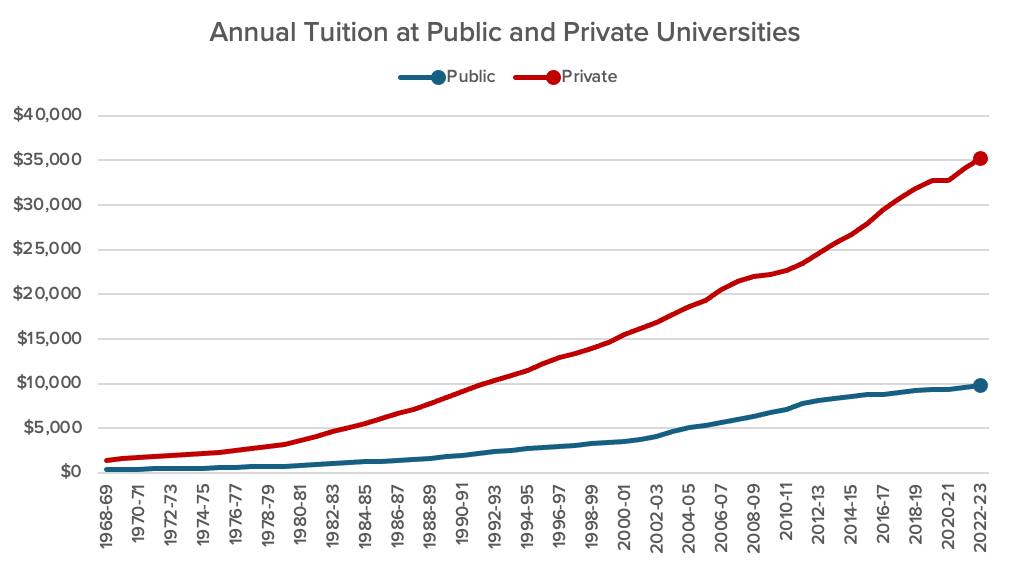
Looks like college tuition is getting more expensive. EducationData.org reports public university tuition increasing 2,937 percent from $321 in 1968-69 to $9,750 in 2022-23 and 2,388 percent for private universities ($1,417 to $35,248).
But what about the time price of tuition? If you had an entry-level job, how many hours did it take to pay tuition at a public university? Could you spend your summer working full-time (480 hours) and pay your tuition? Looks like until around 2002 this was possible. The time price of tuition at public universities peaked around 2015 at 786 hours. The good news for students is that time price has since fallen by 27 percent to 575 hours.
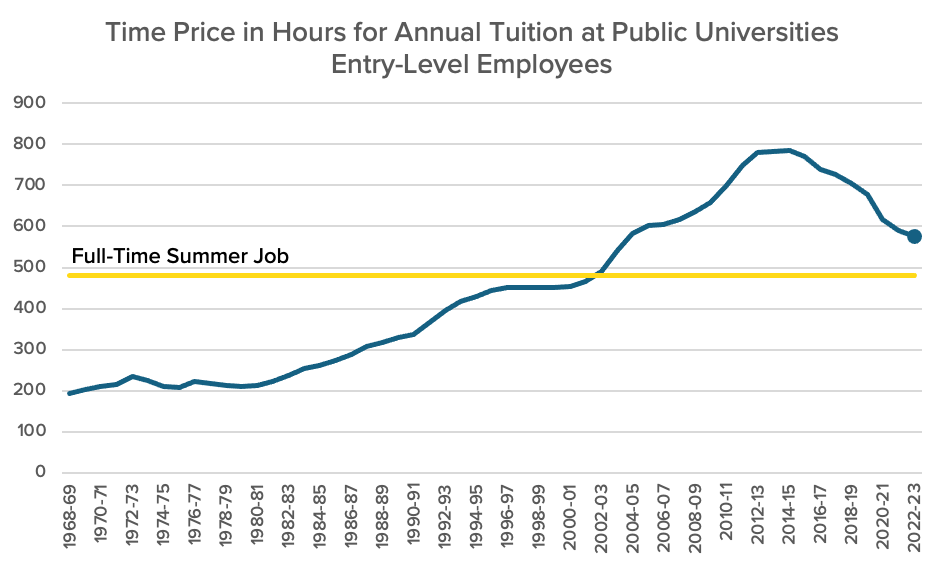
Since 2015 tuition has increased 14 percent but entry level hourly wages have increased 56 percent. This is why college is more expensive and also more affordable at the same time. Remember as long as hourly wages are increasing faster than prices, the time price is decreasing.
Will the time price of tuition ever get back to a summer job? There is a good chance given innovation and competition. The great promise of AI is that it will dramatically reduce the time and cost to learn.
COVID lockdown policies accelerated Zoom classes for college, but AI has yet to make a significant contribution. As we noted in an earlier article, that’s changing fast. Higher education is a prime candidate for disruptive innovation, perhaps even some destructive innovation. A promising program for this innovation is Alpha School. While they are currently focusing on K-12, the innovations could be applied to higher education. An excellent story about Alpha School and its founders, Joe Liemandt and MacKenzie Price, can be read at Collossus.
Alpha School looks like they could be the SpaceX of K-12 education. SpaceX was founded in 2002 and launched the Falcon 1, their first rocket in 2008. They’ve reduced the cost of putting cargo into orbit from $54,500 per kg (Space Shuttle) to $2,720 per kg (Falcon 9), a 95 percent reduction, and potentially to $67 per kg (Starship), a 99.88 percent reduction. Elon’s target with Starship is $10 per kg, indicating a 99.98 percent reduction. Musk hopes to orbit 5,450 kg for the price of one kg.
Exponential Learning Curves
Elon Musk’s companies collect massive amounts of relevant data and then use AI to transform that information quickly and cheaply into actionable knowledge for continuous improvements. Joe Liemandt is doing the same for education. Liemandt has spent the last three years and $1 billion of his own money to develop his AI system. His Alpha School, Timeback product, and mastery-based learning approach allows students to complete core subjects in two hours daily. On average, Alpha students advance 2.6 times faster than peers on nationally normed Measures of Academic Progress (MAP) tests and typically score in the 99th percentile. Their best students achieve up to 6.5x their cohort. Once again, class is only two hours a day. Alpha combines adaptive AI for personalized 1:1 learning, mastery-based methods for deep understanding, and time management techniques to keep students focused and thriving. If programs like this can be adapted to higher education, the cost could fall dramatically.
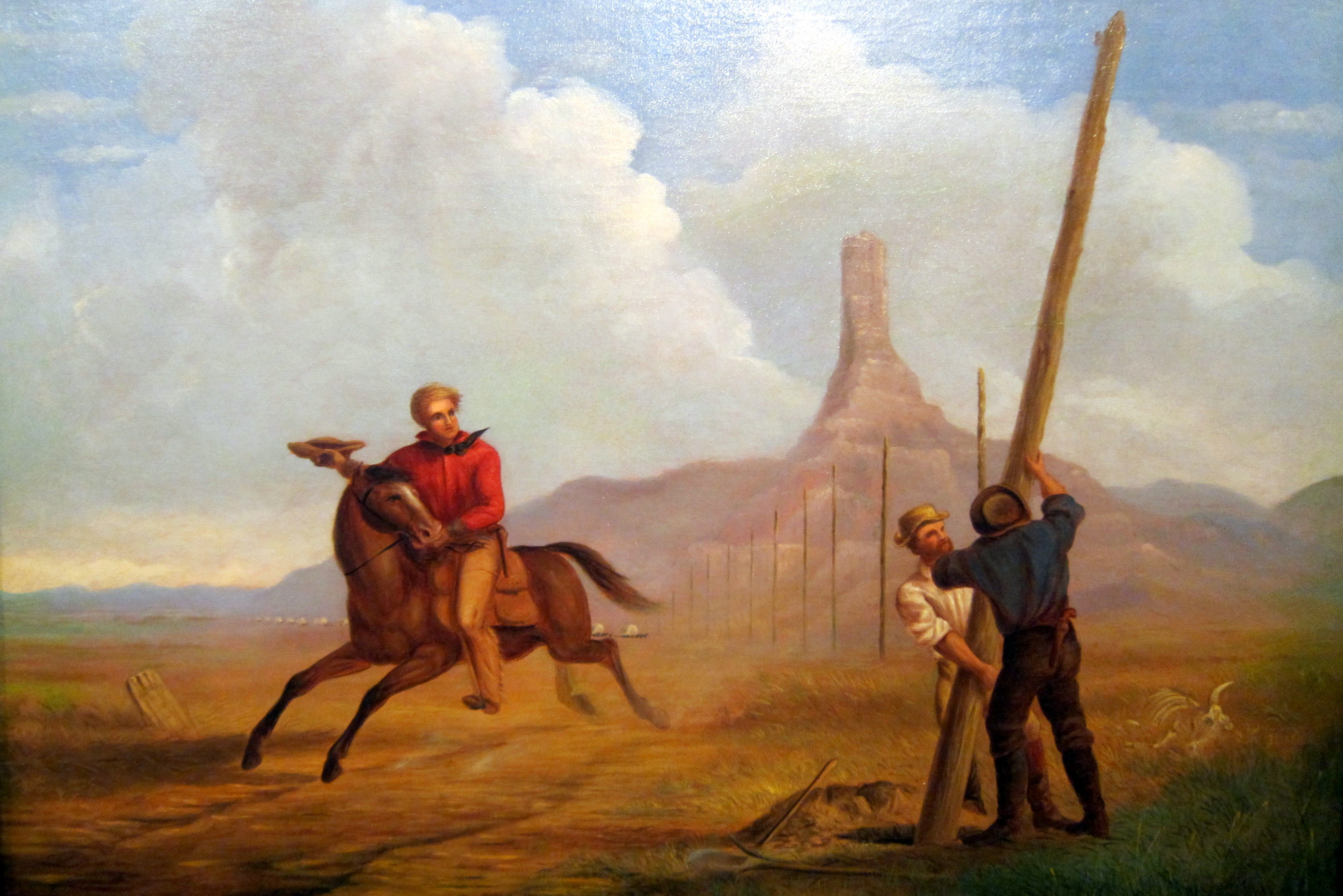
Imagine working one week to pay a full year of tuition? Remember the time to send a letter from St. Joseph, Missouri to Sacrament, California fell from 10 days to 10 seconds on October 26, 1861.
Learn more about our infinitely bountiful planet at superabundance.com. We explain and give hundreds of examples why more people with freedom means much more resource abundances for everyone in our book, Superabundance, available at Amazon.

Gale Pooley is a Senior Fellow at the Discovery Institute, an Adjunct Scholar at the Cato Institute, and a board member at Human Progress.
Inflation creates illusions. While tuitions are still increasing, hourly income is increasing faster. It’s why we must always compare the changes in money prices to the changes in hourly income.
Interesting.
I would be interested in seeing an analysis in why the real tuition in public universities has fallen since 2014. This new trend gets very little press coverage.