
Mac Abundance
Get almost 16 new Macs for the time price of one in 1984

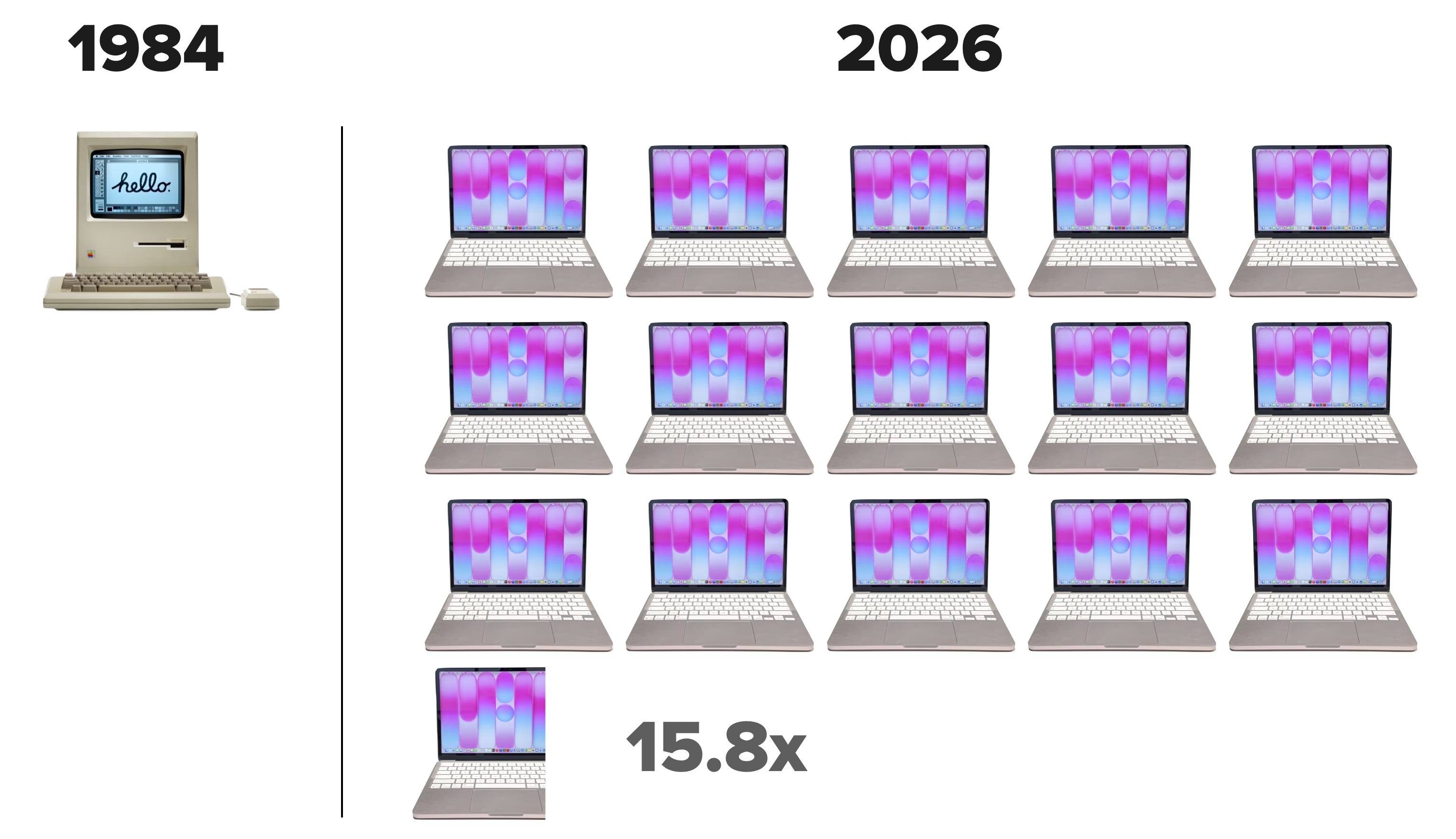
In 1984, Steve Jobs stepped onto the stage and unveiled the Apple Macintosh for $2,495. At the time, unskilled workers earned about $5 an hour, placing the time price of that machine at roughly 499 hours. I was sold on the Mac the first time I used a mouse to change the width of a column in their spreadsheet program. Goodbye Lotus 1-2-3 and MS-DOS.
Recently, Apple announced the new MacBook Neo for $599. With entry-level limited-service restaurant wages around $18.95 an hour, the time price has fallen to 31.6 hours.
That’s a 93.7 percent collapse in the time price.
In other words, for the time it took a worker in 1984 to earn enough to buy one Macintosh, a worker today can buy 15.8 MacBook Neos.
Students and teachers can buy one for $499. They’re getting 19 for the time price of one in 1984.
Apple will even finance the purchase at 0 percent interest for 12 months—about $49.91 per month, or roughly $1.67 per day. At today’s entry-level wages, that means working a little over five minutes a day to access a device built on more than $245 billion in Apple research and development costs over the past two decades.
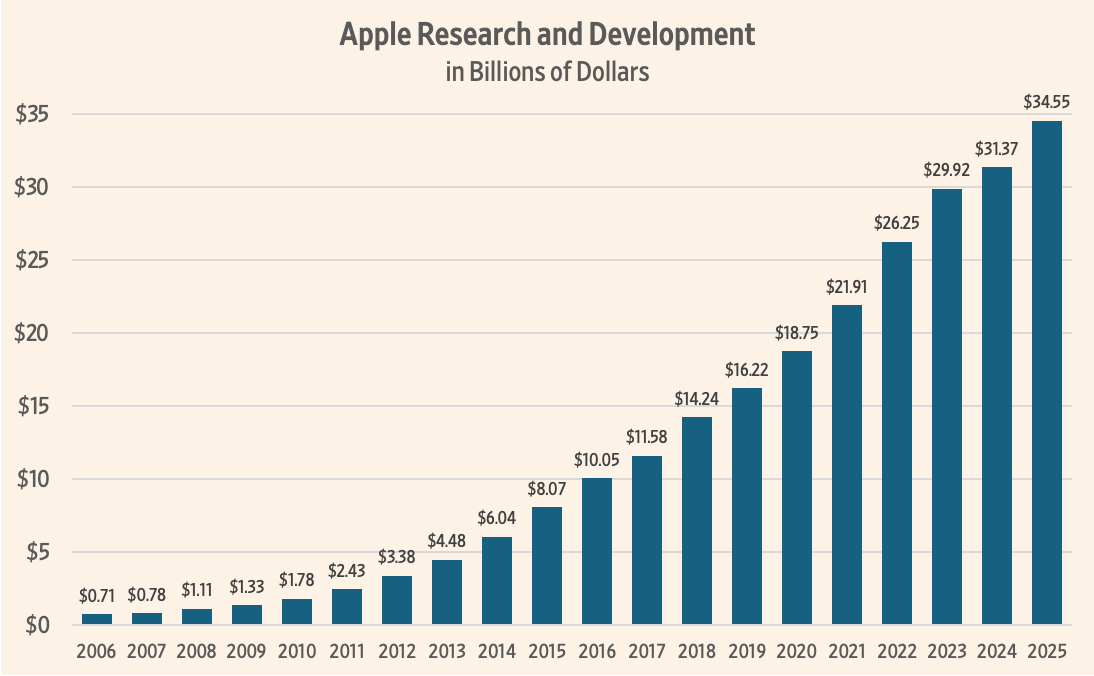
How is it possible that we can enjoy such abundance for five minutes a day?
First, we live in a society where people are free to innovate and share the knowledge they discover.
Second, there are so many of us. Apple can spread these development costs across billions of customers. If there were only a million people on the planet, a Mac would have to sell for almost $500,000 before it made sense for Apple to build it.
Since 1984, Apple has sold hundreds of millions of Macs. Each generation has required fewer hours of human work to deliver exponentially more computing power—a vivid illustration of the falling time price of knowledge.
But the deeper story is not merely more affordable machines.
The 2026 Mac Neo and the 1984 Macintosh share a name, but little else. Comparing them is like comparing a Ferrari to a bicycle.
Ignoring collector value, how many 1984 Macs would I have to give you for your new Neo?
Ten?
A hundred?
A thousand?
Most people wouldn’t trade, period.
And that reveals something profound about economic progress. When innovation advances far enough, comparison itself begins to break down. The new product does not merely improve on the old—it renders it obsolete.
By that measure, the improvement isn’t just large, it approaches infinite.
The modern Mac is not simply a more affordable computer. It’s a gateway to the global network of human knowledge—powered by processors billions of times faster, carrying libraries, laboratories, studios, and marketplaces in a device thinner than a magazine.
In this sense, the real story of technology isn’t falling prices, but the exploding power of human knowledge, compounding generation after generation until yesterday’s miracles become today’s antiques.
When Apple introduced the Macintosh, the moment was immortalized by a legendary Super Bowl commercial directed by Ridley Scott during Super Bowl XVIII. The ad promised to shatter the gray conformity of the computer age.
Four decades later, the deeper revolution is clear: knowledge keeps compounding, and the time price of the future keeps falling.
Note: If you had invested $1,000 in Apple stock in 1984, it would be worth around $2,500,000 today, not including reinvested dividends. That would be a 2,500x increase, or around 20.4 percent compound annual rate of growth. Thanks Steve.
People like Steve Jobs have transformed our world with their creativity, vision, and entrepreneurship. We honor his life and work to lift humanity. Here is Jobs doing his first demo:
Here’s another memorable ad that reflected his vision for creative work:
Final Question: How many Steve Jobs were born today? Will they have the freedom to innovate like he did?
Please let me know in the comments if there is a product you would like to see analyzed in a future article.