


The U.S. Energy Information Administration notes that the average price of a gallon of gasoline reached $4.47 this past week. That sounds expensive, but does the money price really tell us the true price of gasoline?
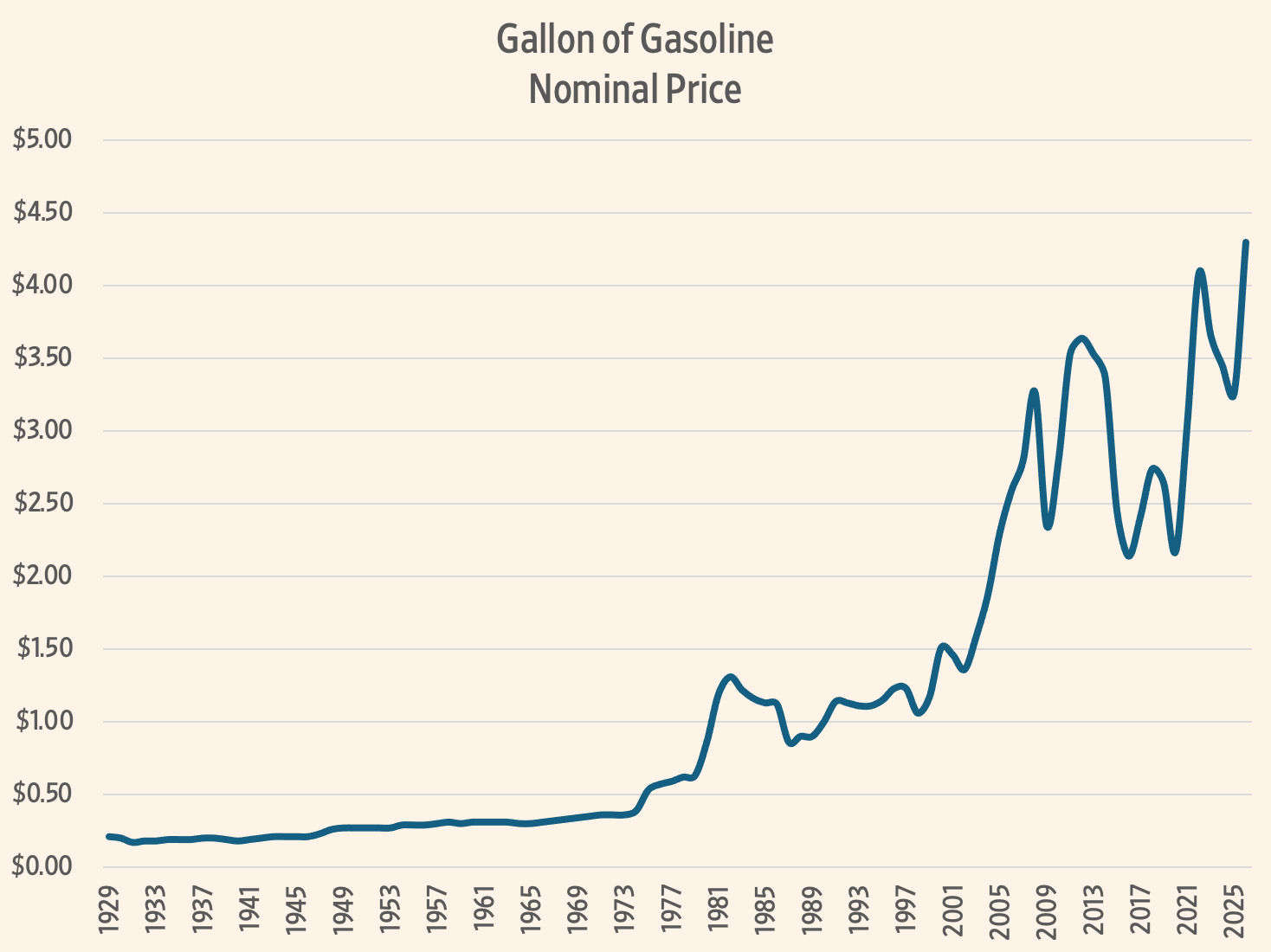
We buy things with money, but we pay for them with our time. That means every product has two prices: a money price and a time price.
Money prices are expressed in dollars and cents. Time prices are expressed in hours and minutes. Converting a money price into a time price is simple: divide the money price by hourly income.
If hourly income rises faster than the money price of a product, its time price falls. The product becomes more abundant.
To calculate the time price of gasoline, we divide the nominal price of a gallon by nominal blue-collar hourly compensation, including wages and benefits, as reported by MeasuringWorth.com*. When we look at gasoline this way, a very different story emerges.
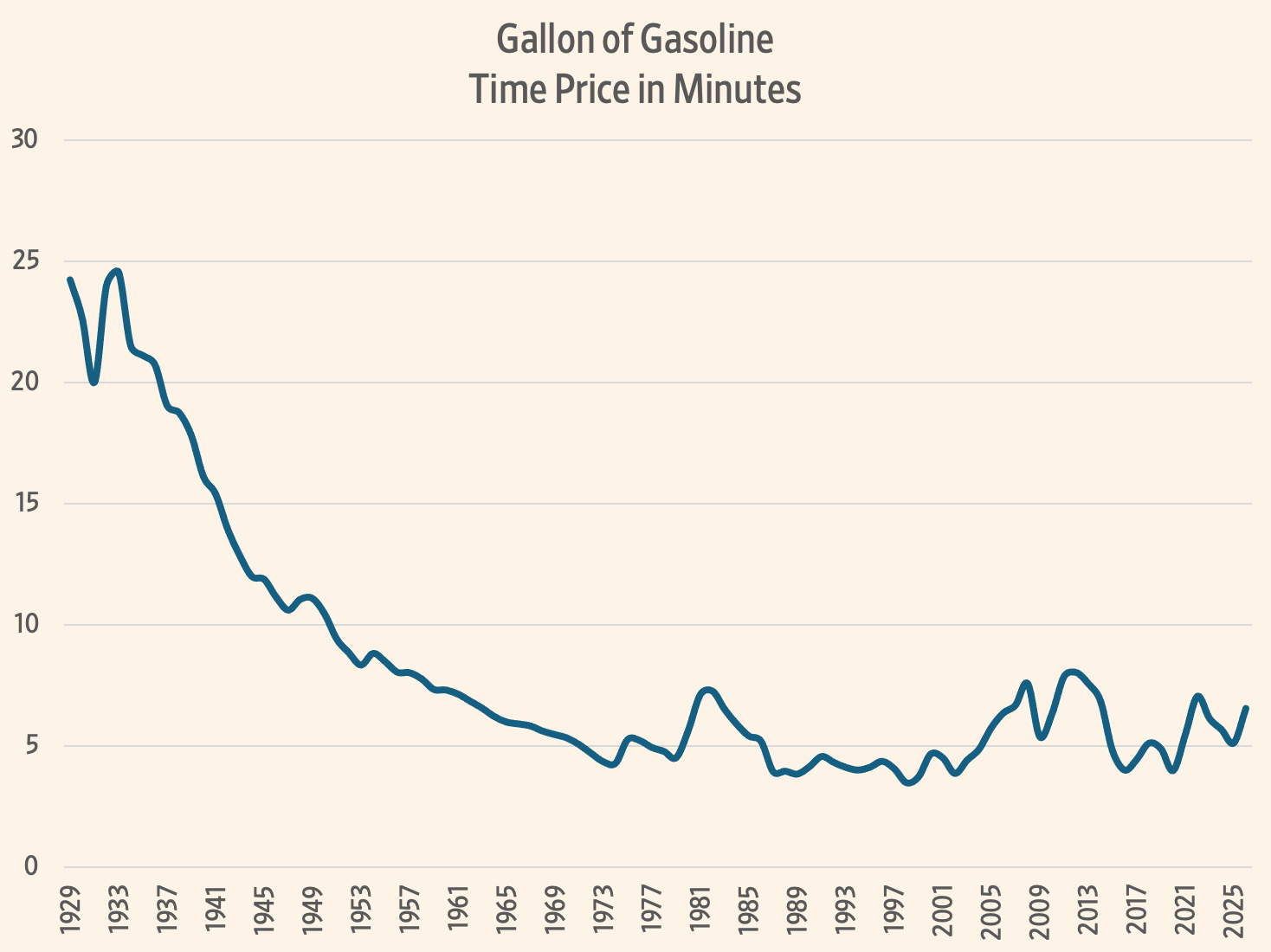
In 1929, it took about 24 minutes of work time to earn enough money to buy one gallon of gasoline. Today, it takes roughly 6.5 minutes. That represents a 73 percent decline in the time price. Put another way, for the amount of time required to earn one gallon of gasoline in 1929, you can buy about 3.7 gallons today. Gasoline abundance has increased roughly 270 percent..
Another interesting way to think about the time price of a resource is to consider how many gallons of gasoline one hour of time would buy. Call this gallons per hour or GPH. This ratio reveals how much abundance is changing over time.
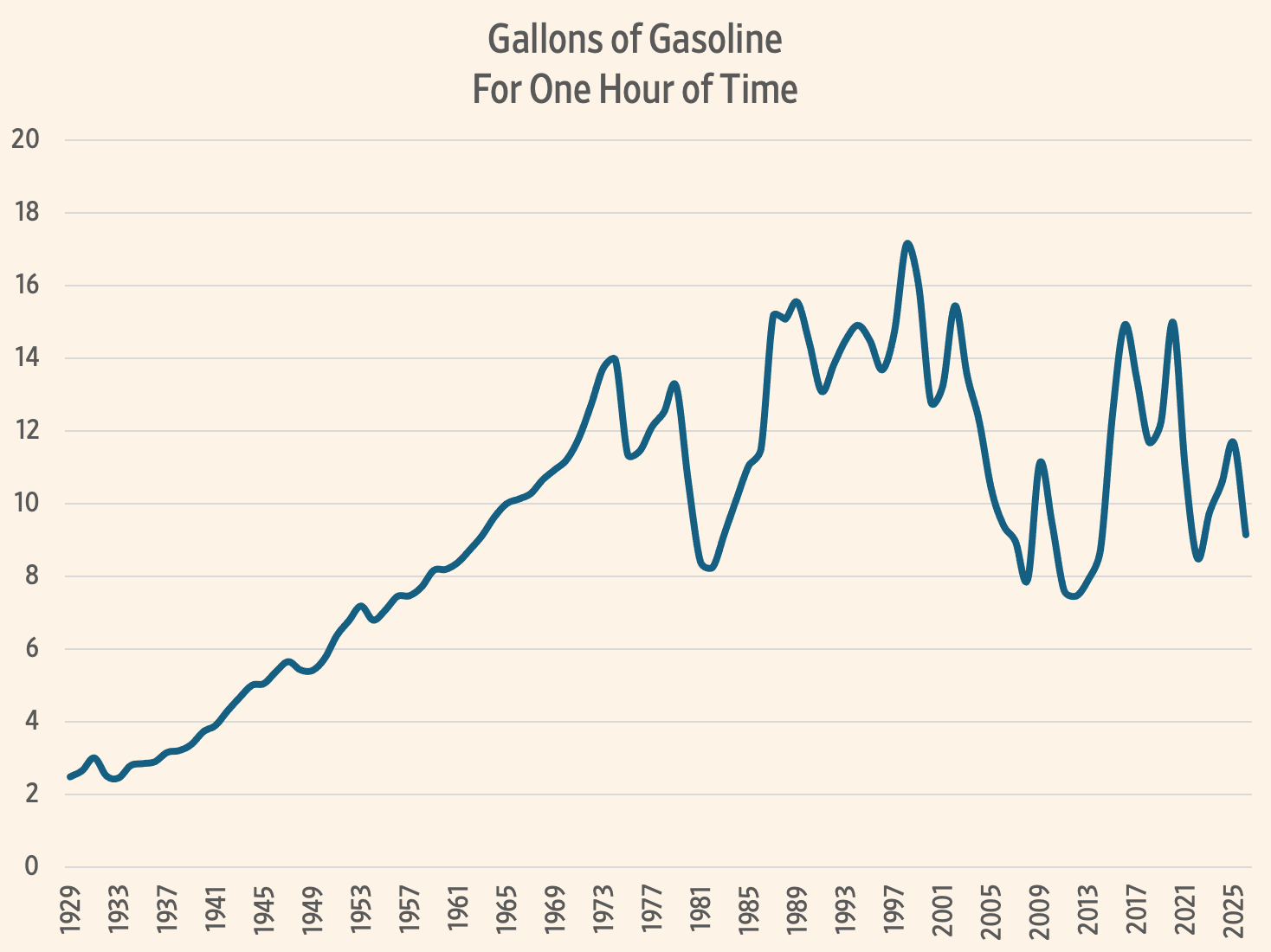
In 1929, one hour bought about 2.5 gallons. By 1973, gasoline abundance had increased more than 450 percent, to roughly 14 gallons per hour. Then came the oil shocks of the 1970s. OPEC restricted supply and prices surged. By 1982, an hour of time bought only about 8.2 gallons. But the decline did not last. New supplies, new technologies, increased competition, and rising productivity pushed abundance higher again. By 1998, an hour bought about 17.2 gallons, the highest level in the series.
World events later reversed some of those gains. By 2012, abundance had fallen to about 7.5 gallons per hour, but then recovered to around 15 gallons per hour by 2020.
Recent geopolitical disruptions have pushed gasoline prices sharply higher again. But short-term shocks should not be confused with the long-term trend. Over many decades gasoline has become more abundant, requiring fewer hours to obtain each gallon.
There is another dimension to gasoline abundance that the pump price misses entirely: what a gallon actually does for you.
Consider fuel economy.
The Oldsmobile Cutlass, one of America’s best-selling cars in 1980, averaged roughly 20 miles per gallon. A modern Toyota Camry Hybrid can achieve around 50 miles per gallon. In other words, a gallon of gasoline can now take you roughly two and a half times as far.
That means measuring gasoline only by dollars per gallon understates the improvement. What ultimately matters is transportation, not gasoline itself.
The same principle applies to the automobile.
A new Oldsmobile Cutlass cost about $6,735 in 1980. At blue-collar compensation of about $9.12 per hour, its time price was approximately 738 hours. A new Camry today costs around $29,600. At compensation of about $39.32 per hour, its time price is roughly 753 hours. The time price is remarkably similar, but the product is not.
Today’s Camry travels much farther on a gallon of gasoline and offers dramatically greater safety, reliability, comfort, emissions control, electronics, and performance.
Now combine the cost of the car with the gasoline required to drive it 100,000 miles. In 1980, buying a Cutlass and enough gasoline to drive 100,000 miles required roughly 1,209 hours of time. Today, buying a Camry and enough gasoline to drive the same distance requires roughly 980 hours. That is a decline of about 19 percent in the time required to obtain the car and travel 100,000 miles. And the modern driver gets a vastly better vehicle in the bargain.
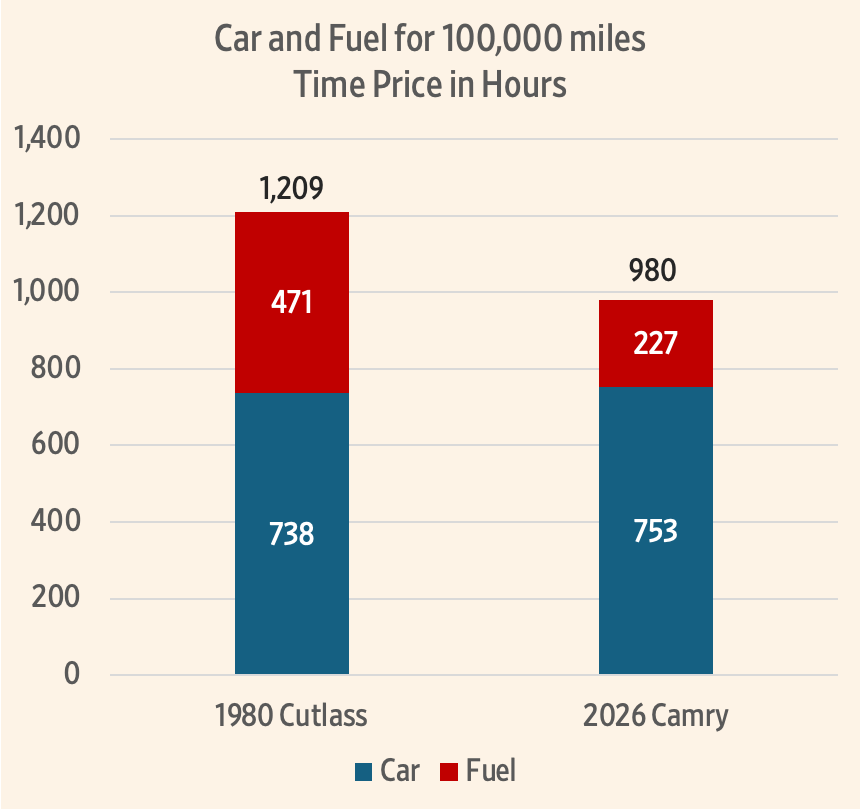
Gasoline may look expensive when measured only in dollars, but dollars are not what ultimately matters. Time is what matters. Over the long run, Americans trade less time to obtain gasoline, while each gallon has become more productive and the cars using it have become safer, cleaner, more reliable, and more capable.
That is the deeper story of abundance. Innovation does not merely lower the price of resources, it increases what resources can do. The real measure of progress is not how many dollars something costs, but how much of your life you must give up to buy it.
Thanks innovators and free-market capitalism.
* estimated value for 2026