


The Bureau of Labor Statistics (BLS) tracks airfares while the U.S. Department of Transportation monitors enplanements (passenger boardings). Since 2000, U.S. population grew 22 percent while enplanements increased by 51 percent, and the time price of airfares for blue-collar workers decreased by 49 percent. This means that in 2025, these workers get 2.04 airfares for the same amount of time it took to earn the money to buy one airfare in 2000, indicating a 104 percent increase in abundance. Every one percent increase in population corresponded with a 4.73 percent increase in personal airfare abundance (104 ÷ 22).
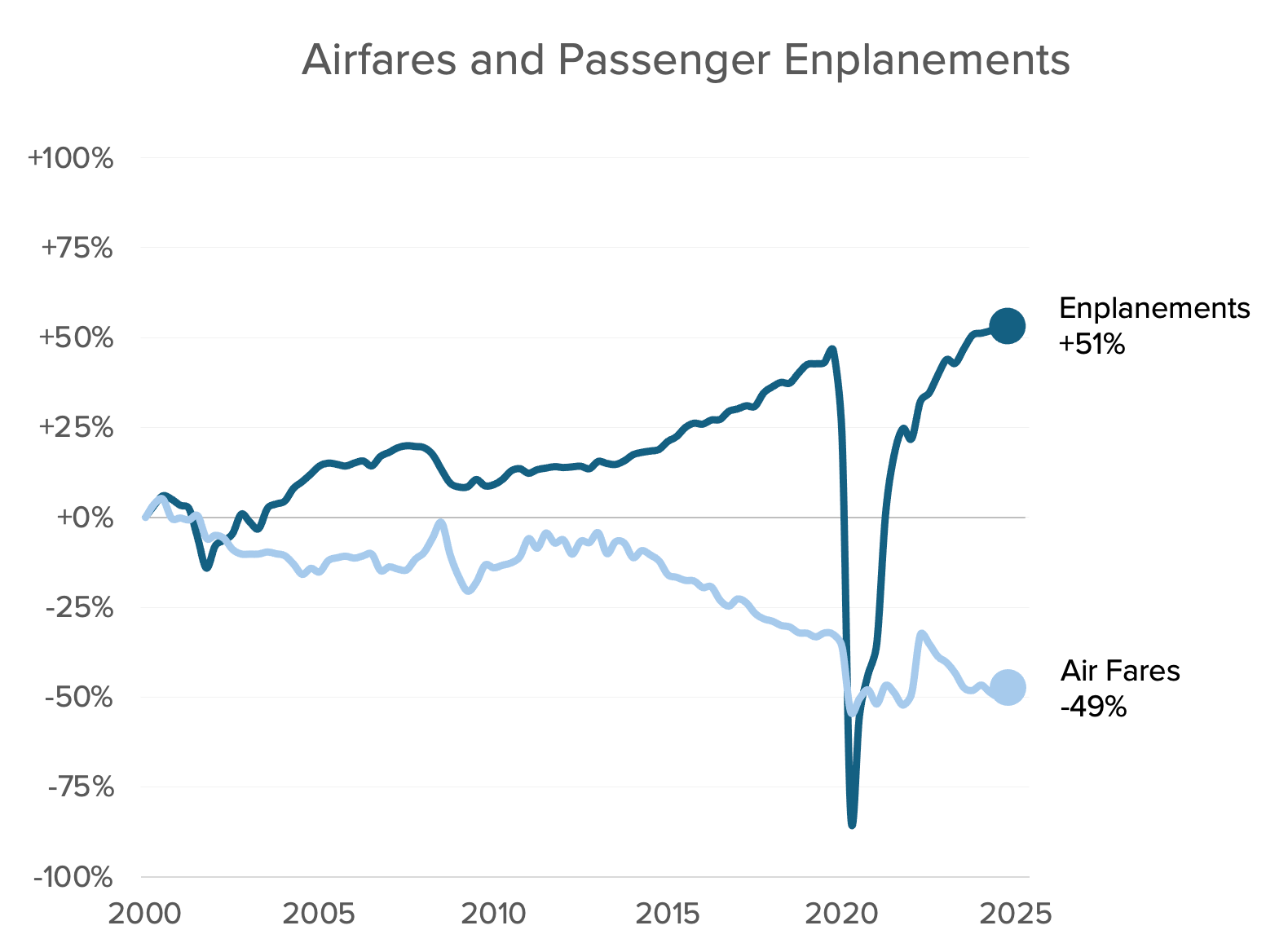
The historical chart clearly shows the impact of major disruptions: the September 11th attacks, the 2008 financial crisis, and the sharp decline from COVID-19 pandemic policies.
You can also analyze total airfare abundance by combining airfare time price abundance with increased passenger enplanements. To visualize this, we plot airfare time price abundance on the vertical axis and enplanements on the horizontal axis, creating comparative boxes for 2000 and 2025 and then overlay them.
Using 2000 as our baseline (setting both variables to 1.0), the initial box measures 1.0 × 1.0 = 1.0. By 2025, enplanements had grown 51 percent (to 1.51) while airfare abundance increased by 104 percent (to 2.04). The 2025 box therefore measures 1.51 × 2.04 = 3.08. Going from a 2000 box size of 1.0 to a box size of 3.08 is a 208 percent increase in total airfare abundance over 25 years, equivalent to a compound annual growth rate of 4.6 percent. At this pace, airfare abundance doubles approximately every 16 years.
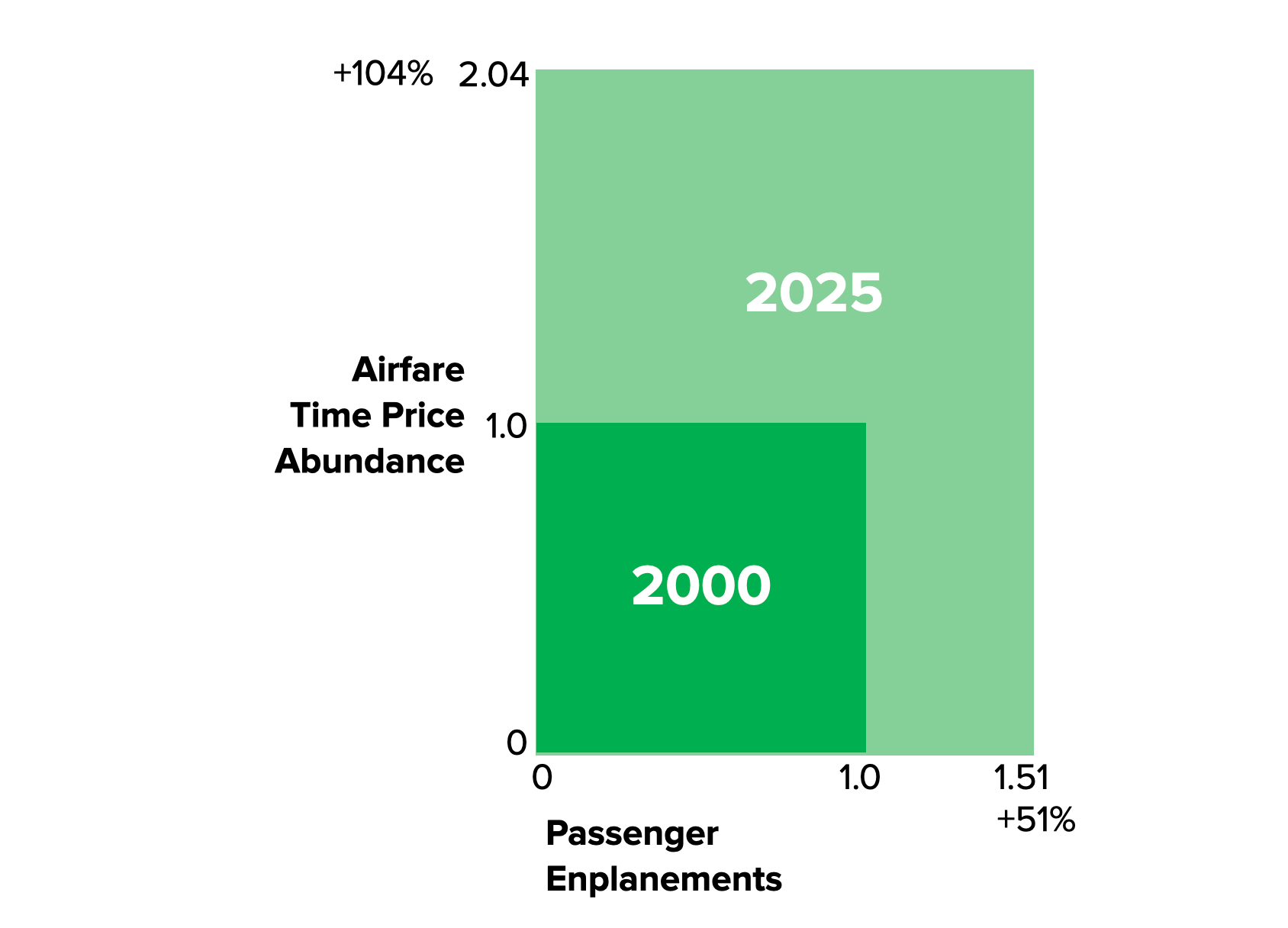
We also note that every one percent increase in population corresponded with a 9.45 percent increase (208 ÷ 22) in personal airfare abundance.
Tip of the Hat: Maxwell Tabarrok
Learn more about our infinitely bountiful planet at superabundance.com. We explain and give hundreds of examples why more people with freedom means much more resource abundances for everyone in our book, Superabundance, available at Amazon.

Gale Pooley is a Senior Fellow at the Discovery Institute, an Adjunct Scholar at the Cato Institute, and a board member at Human Progress.
Also, when people talk about degrowth, I don't think they fully understand what that means for economies of scale.
This is a great point.
I wrote about people misunderstanding when they're being ripped off, including for air travel, here: https://open.substack.com/pub/andrewperlot/p/how-know-youre-being-ripped-off?r=1xulhu&utm_campaign=post&utm_medium=web&showWelcomeOnShare=false